On October 15, 2025, former U.S. Senator Kyrsten Sinema made a surprise (and under-the-radar) appearance at a local planning and zoning meeting, where she aggressively argued in support of a large artificial intelligence data center proposal in Chandler, Arizona.
No one knew why, but we could guess.
* * *
You can find a user-friendly PDF version of this document here. The full batch of FOIA records is available upon request. Please note that I lightly redacted certain sender and recipient contact information in the emails cited below.
* * *
Sinema had cannon-balled into the private sector after her early retirement and, despite not registering as a lobbyist, certainly was acting like one.
Weeks after joining Coinbase’s Global Advisory Council, she pushed state lawmakers to approve a cryptocurrency bill (HB2749) that her company had been lobbying for. Weeks before joining Hogan Lovells, she helped draft another bill (HB2871) appropriating $5 million toward ibogaine, tied to a pharmaceutical company represented by her lobbying firm. Then she was spotted on the U.S. Senate floor.
And now an AI data center?
In her remarks before the Chandler Planning and Zoning Commission, caught on video by the City’s public-access channel, Sinema said that “I’m here tonight on behalf of Active Infrastructure” and described herself as “the founder and co-chair of … the AI Infrastructure Coalition.” She claimed to be “work[ing] hand-in-glove with the Trump administration” and starkly warned the Commission that, if the city chose “not to move forward with development,” “federal preemption is coming.”
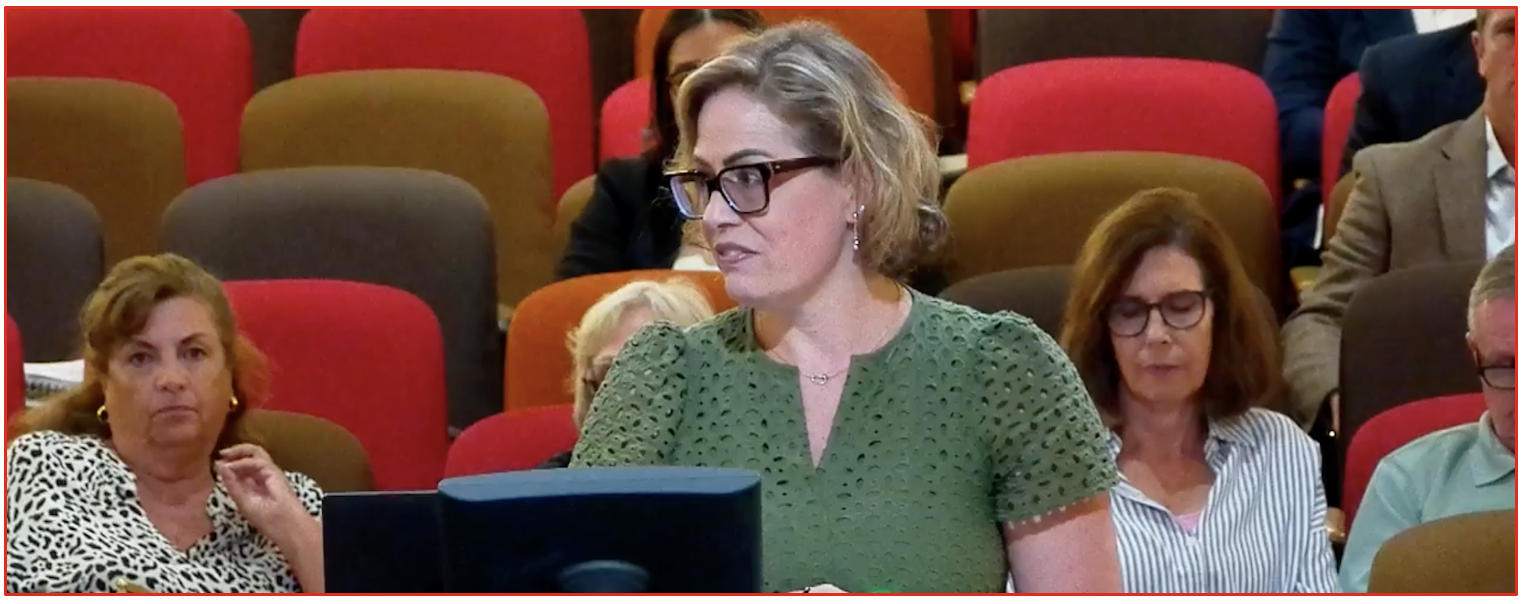
The federal threat and “hand-in-glove” coordination struck me as odd in light of the rules requiring former members of Congress to partake in a cooling-off period before lobbying.
So, I filed a FOIA request seeking emails between Sinema, her associates, and the City of Chandler. What I found in the 121 pages of responsive records is that her behind-the-scenes pressure campaign has been going on for months longer than the public knew—and while the former senator may not call what she’s doing “lobbying” … well, take a look at the timeline below and decide for yourself.
The City Council’s vote on her AI data center is scheduled for December 11.
* * *
On June 3, 2025, Mayor Kevin Hartke shares a same-day meeting invitation with Vice Mayor Christine Ellis titled “Price Road Innovation Campus: Discussion.” One of the invitees is Jeff Zygler, founder and CEO at Active Infrastructure, the company that Sinema spoke “on behalf of” before the planning and zoning commission.
Later that evening, Councilmember Angel Encinas’s office emails Zygler to “reschedule” an upcoming meeting. Zygler adds Adam Baugh, a partner at the Phoenix law firm Withey Morris, to the email chain and notes that “Adam was communicating with the councilman over text this week.” (Bough specializes in helping developers “succeed in environments that frequently appear hostile to development.”)
They schedule a June 11 meeting with Councilmembers Encinas and Jane Poston. A separate email notes that “Sinema would be joining.”

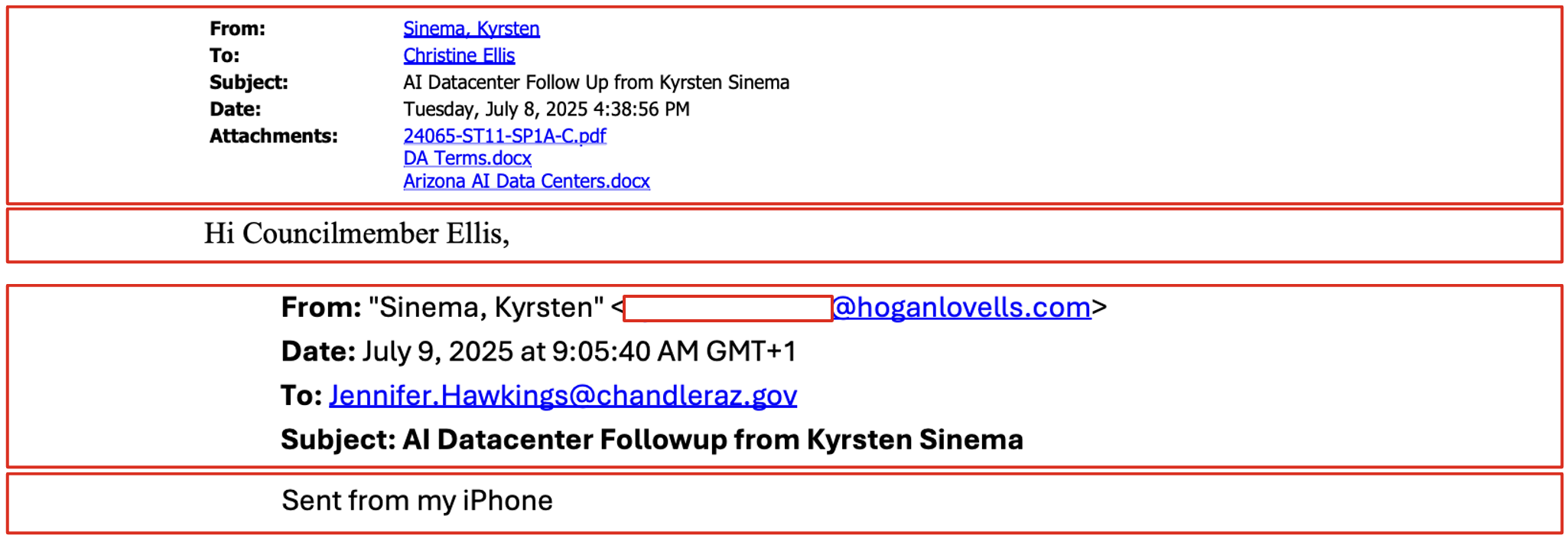
The week of July 8, Sinema (using her Hogan Lovells email address) sends out a six identical but separate emails to relevant City officials containing a “planned sequencing to allow three development scenarios with an AI data center,” along with “a development agreement we feel is of maximum benefit.”
One email is addressed to “Councilmember Ellis” (her position is Vice Mayor). Another is sent to Councilmember “Jennifer Hawkings” (her name is Jennifer Hawkins). All of them are “Sent from my iPhone.”
On July 22, Councilmember Matt Orlando emails Sinema to “apologize for the tardiness of my reply” due to a recent vacation and National League of Cities event and asks to “sit down with you to discuss AI Data Center and our project in Chandler.” Sinema adds her former congressional aide Daniel Winkler, who followed her to Hogan Lovells (and did register as a federal lobbyist), to the email and asks him “to find a time.”
They meet in-person on August 6, after which Zygler shares “images of the main project sign at night (located on the corner of Dobson and Price Roads), close up of the data center and overall speculative development site plan.” Sinema, Baugh, and Winkler are all CC-ed, the latter of whom follows up by citing Hadrian and Anduril Industries as examples of “the economic transformation possible with the growth of AI infrastructure.”
On August 15, Councilmember Hawkins (the one Sinema referred to as “Hawkings”) is notified by a City employee that “Sinema … requested 30 mins of your time if possible” for a meeting on August 22.
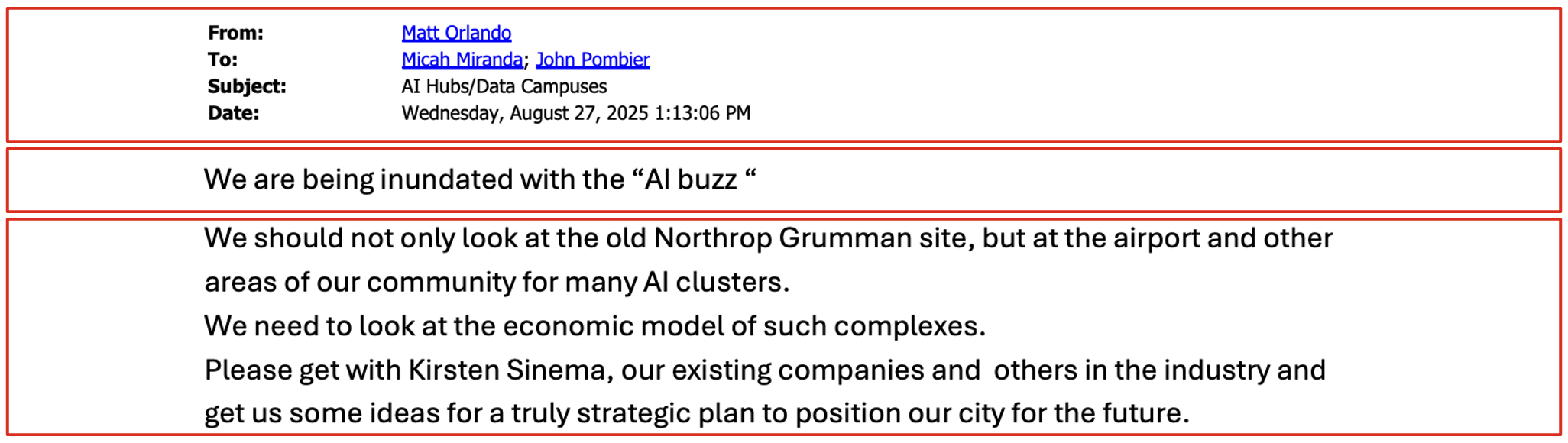
It’s unclear if the meeting happens, but five days afterward Councilmember Orlando tells John Pombier and Micah Miranda, Chandler’s city manager and economic development director, respectively, that “[w]e are being inundated with the ‘AI buzz’” and wonders whether an AI project “messes with our existing chip manufactures as well as long term Econmic growth.”
He asks them to “get with Kirsten Sinema” and suggests that the City “not only look at the old Northrop Grumman site, but at the airport and other areas of our community for many AI clusters.”
On September 10, Sinema’s aide notifies Councilmember Hawkins that he’s aware she met with Austin Kennedy, executive director at the Arizona Business Roundtable (another group led by the former senator), earlier that day at NXP Semiconductors. He forwards her “some recent developments that are pertinent to the Price Road data center project Senator Sinema and I are working on”: Two paragraphs about Hadrian and Anduril Industries copied-and-pasted from his email to Councilmember Orlando the previous month.
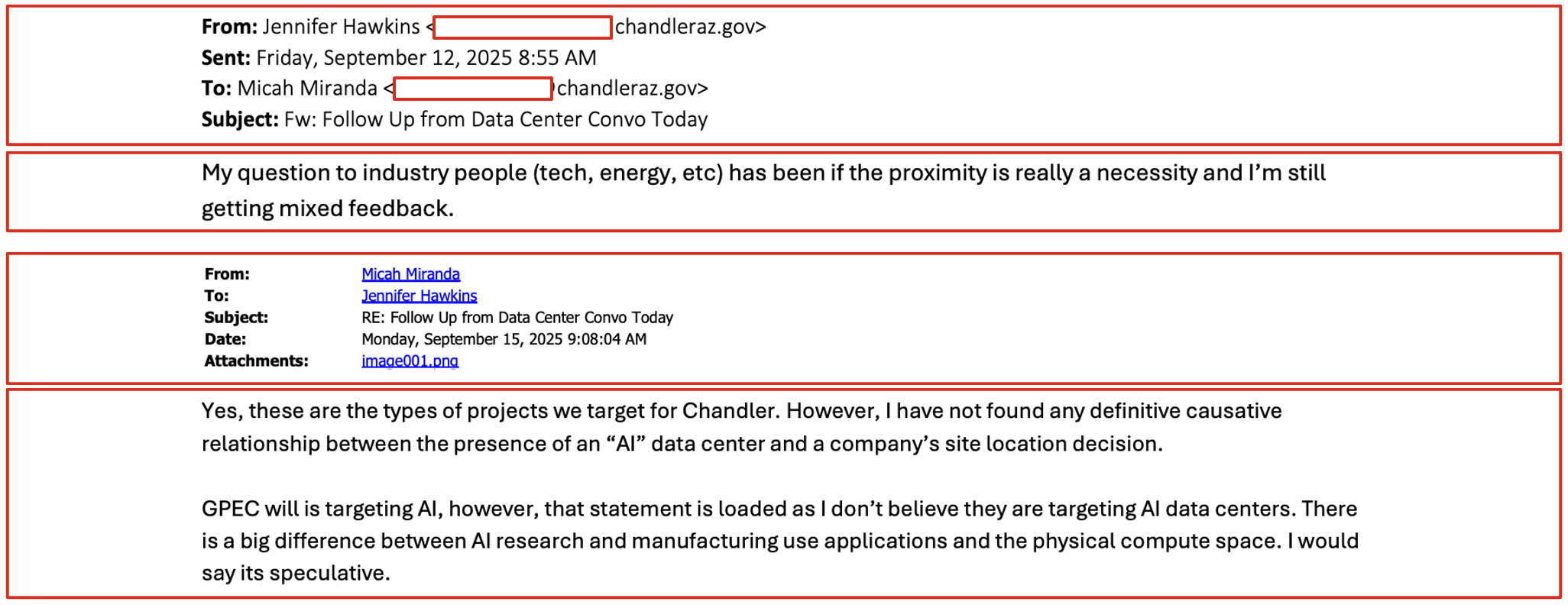
Councilmember Hawkins flags the email for the City’s economic development director and says that she’s been asking “industry people” whether “proximity” to AI data centers “is really a necessity and I’m still getting mixed feedback.”
The director says that “I have not found any definitive causative relationship between the presence of an ‘AI’ data center and a company’s site location decision.” He continues: “There is a big difference between AI research and manufacturing use applications and the physical compute space. I would say its speculative.”
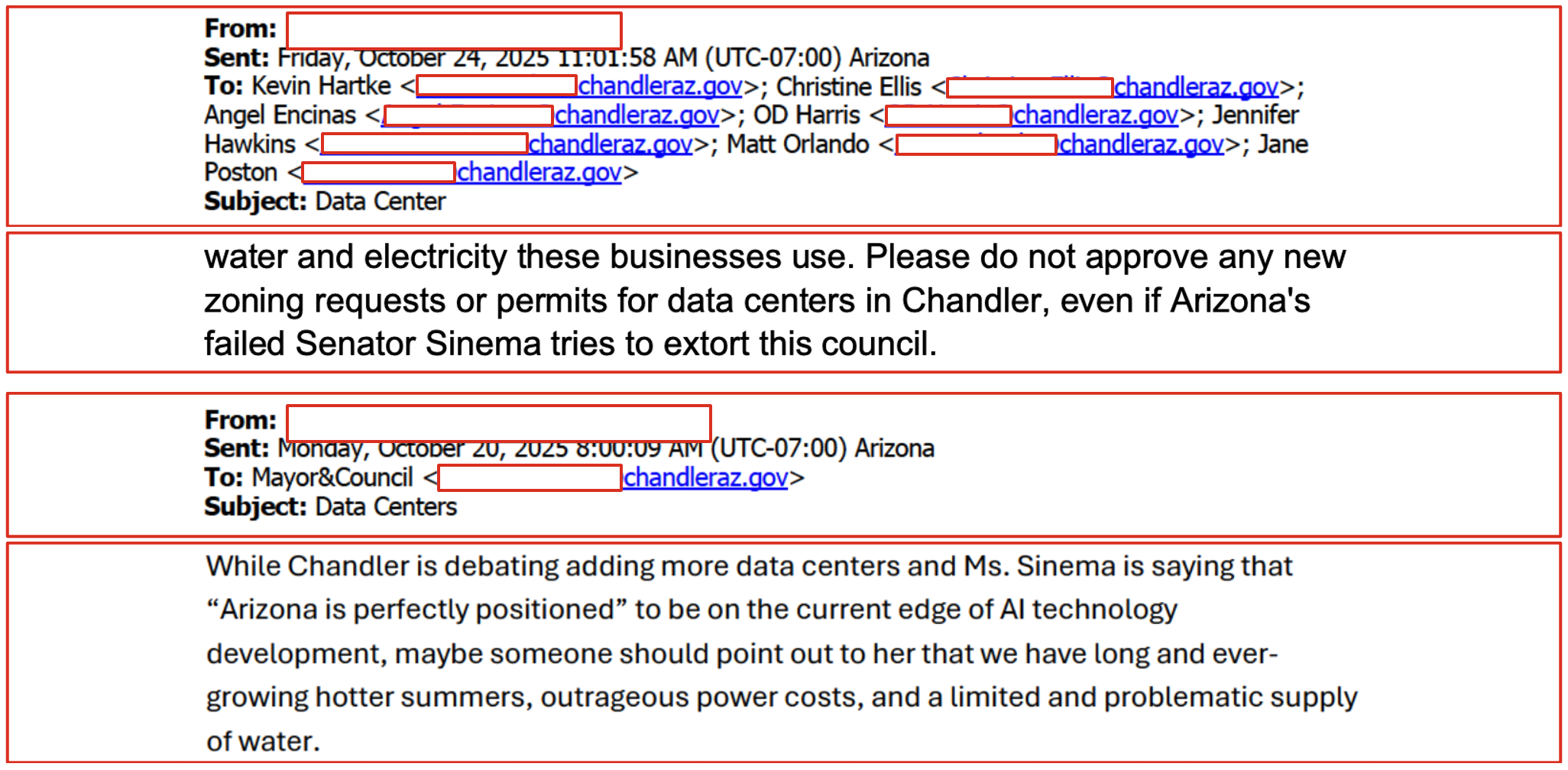
On October 15, Sinema speaks before the Planning and Zoning Commission. Her controversial remarks inflame long-growing scrutiny of the project. One longtime resident (in an email to City officials) criticizes the former senator for “tr[ying] to extort this council.”
Another resident writes that “there are far less destructive ways” to create jobs and urges the mayor and councilmembers to “point out to her [Sinema] that we have long and ever-growing hotter summers, outrageous power costs, and a limited and problematic supply of water.”
The Chandler City Council’s regular meeting (and vote) on the AI data center will be held on December 11.
Update: The Chandler City Council voted 7-0 against the data center.
###
 FOIAzona
Leave a comment